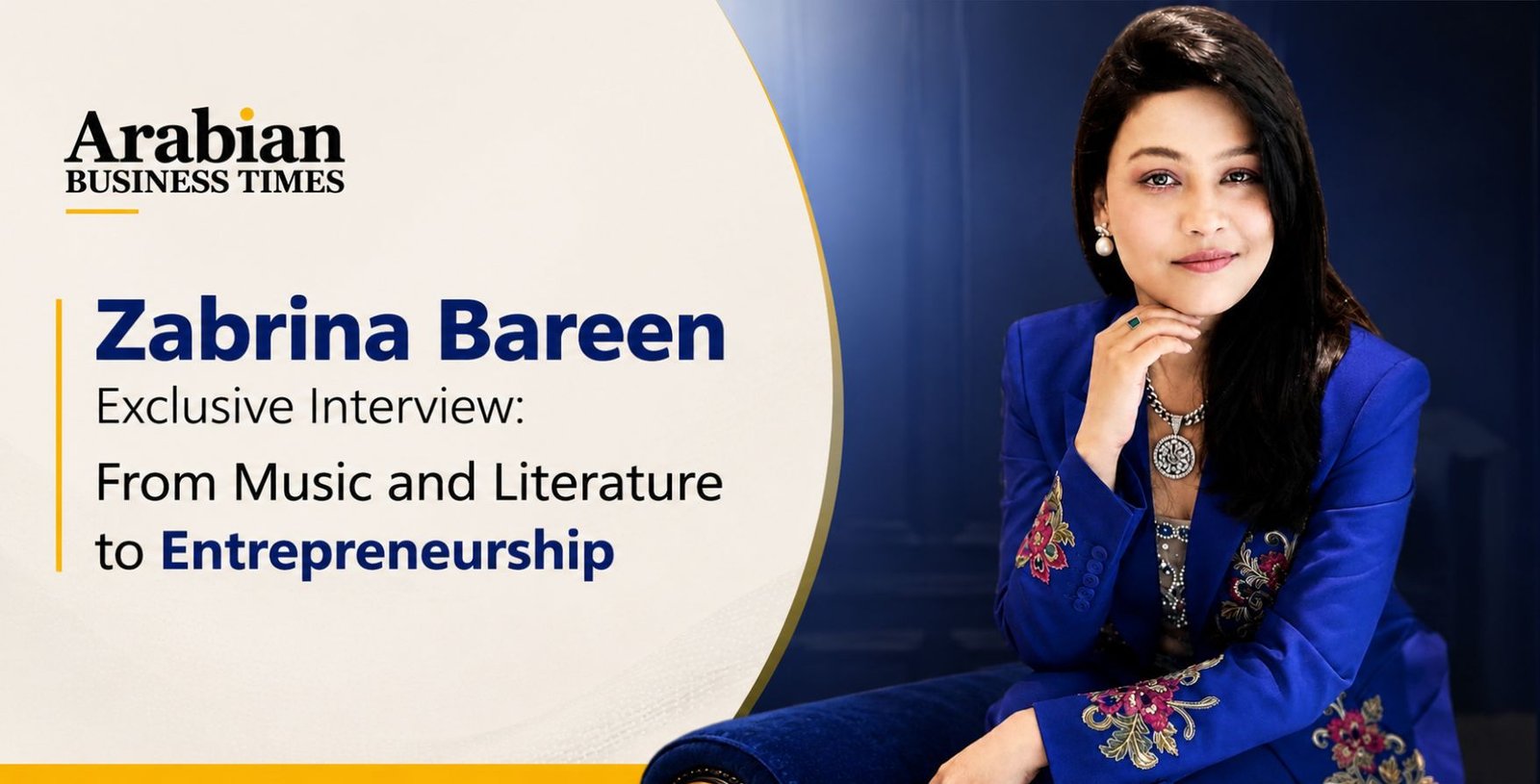
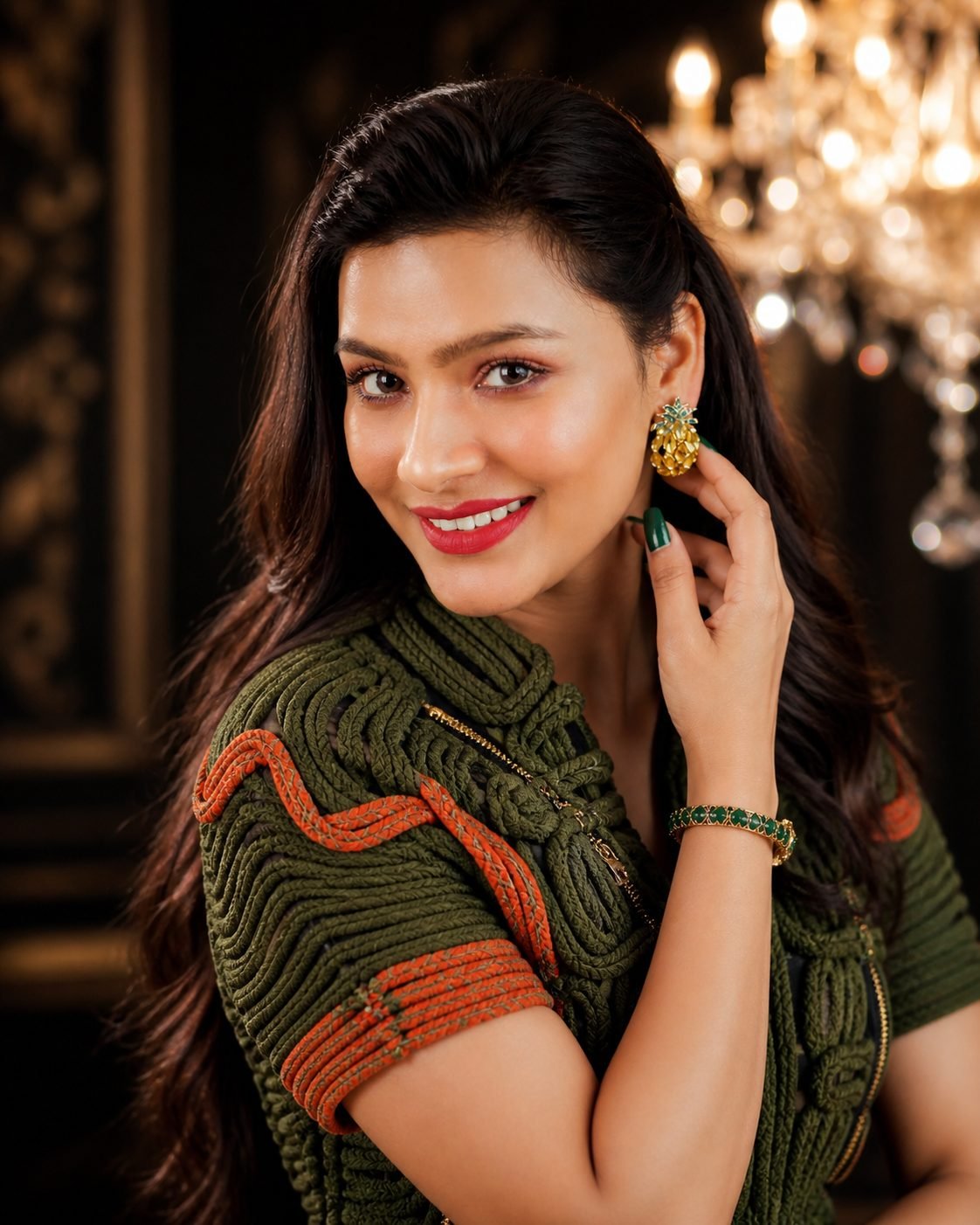
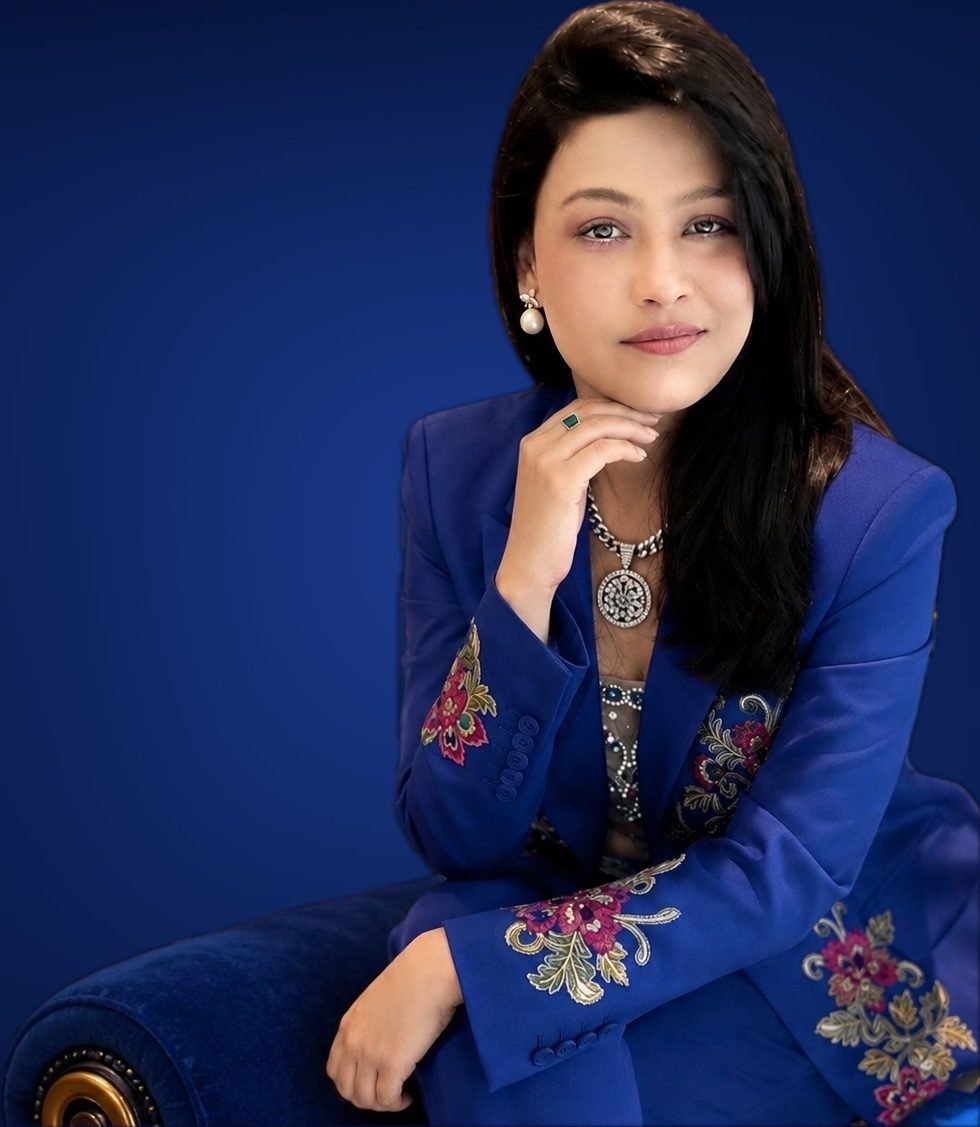
Some careers are built by following a plan, while others evolve through passion, purpose, and persistence. Zabrina Bareen is a remarkable example of the latter. As an accomplished artist, singer, author, entrepreneur, and founder of Zee Jewels, she has transformed creativity into a powerful force for inspiration, personal branding, and business success.
In this exclusive interview with Arabian Business Times, Zabrina reflects on her journey across music, literature, entrepreneurship, and personal growth. She shares how resilience, authenticity, and consistency have shaped her career, while offering valuable insights for aspiring creators, entrepreneurs, and changemakers looking to leave a meaningful impact on the world.
1. Your journey combines creativity, entrepreneurship, and authorship. What inspired you to pursue these different paths, and what has been the defining moment of your professional journey?
I have never experienced creativity, entrepreneurship, and authorship as three separate paths that I consciously chose to walk, one after the other, the way a résumé might suggest. They were never a decision. They were a single voice, expressing itself through whatever vessel the moment demanded of it — sometimes a melody, sometimes a verse, sometimes a boardroom, sometimes a brand.
It began quietly, long before any of it had a name. I was the girl who walked into rooms carrying nothing but her eyes and her ears — sitting at tables, observing, absorbing, taking notes long before I ever took the floor. That silence was not emptiness. It was preparation. It carried me into spaces like the blockchain world, where I stood as one of the few women leaders in rooms built almost entirely without women in mind, and later into the world of modeling, where I learned that presence itself — the way one carries grace into a space — can be its own quiet form of authorship.
Music found me differently. Singing was never a performance I rehearsed for an audience — it was a language I reached for when words alone felt insufficient for what I was carrying inside me. Over the years, that language became more than thirty studio-recorded songs, each one a small, private confession set to sound before it ever became public. People often call me an artist because I sing, because I record, because I have chosen to give emotion a melody rather than let it sit silently in my chest. But the truth is, the songs and the poems have always come from the exact same place — they are simply different instruments, tuned to the same unresolved note within me.
Entrepreneurship arrived with its own demands. Building Zee Jewels was never about ambition for its own sake — it was about proving, table by table, room by room, that grace and strategy are not opposites, and that a woman can build something of real substance without surrendering an ounce of who she is at the door to do it.
And authorship — authorship arrived the way most true things do. Uninvited. It found me during the great stillness of the pandemic, when the world stood suspended at the crossroads of despair and uncertainty, and I turned to the page because it was the one place that asked nothing of me and gave everything in return. What was never meant to leave my private notebook eventually became words that strangers told me had become their lifeline.
If I must name a single defining moment across all of this — the music, the modeling, the boardrooms, the blockchain rooms, the poetry — it would not be a stage, a studio session, or a headline. It was the moment I received the first message from someone I had never met, telling me that my words had carried them through their hardest days. That was the moment every version of me — the singer, the model, the entrepreneur, the writer — collapsed into a single understanding: none of these were separate ambitions. They were one instrument, and I had simply spent my entire life learning how to play it in service of something larger than myself.

As an artist, how do you find inspiration for your work, and what message or emotions do you hope your creations communicate to your audience?
Inspiration, for me, has never been something I go looking for. It finds me in the ordinary moments most people rush past — a conversation that lingers longer than it should, a silence after a hard day when there’s no one left to perform for. I don’t chase it. I stay open enough, honest enough, that it knows where to find me.
What I hope my work communicates is not a performance of emotion, but permission — permission to feel without apologising for it. So many people spend their days editing themselves into something more presentable, more composed, more acceptable for the world to witness. My work exists to gently interrupt that. To remind whoever is listening or reading that they don’t have to hold it together for anyone, least of all for me.
As I have always believed —
“Art is not meant to impress the world. It is meant to undress the parts of us the world taught us to hide.”
That’s really the only ambition behind anything I create — whether it takes shape as a recorded song or a written verse. Not to be heard, but to make sure someone else finally feels seen.
Writing a book is a significant milestone. What inspired you to become an author, and what key message do you hope readers take away from your work?
I want to answer this honestly, even if the honesty complicates the neatness of the question. I did not become an author the way one becomes a lawyer or a doctor — through intention, training, a moment of deciding. I became an author almost against my own awareness of it happening. There was no ceremony to it. There was only a woman, alone with her own unravelling thoughts, refusing to let them dissolve into nothing.
What I have come to understand is that most people assume writing is born from inspiration — a beautiful, poetic word we like to romanticise. But in my experience, writing is far more often born from refusal. A refusal to let a feeling die unexamined. A refusal to let a hard season pass without extracting some meaning from it. I did not write because I had something profound to say to the world. I wrote because I had something unbearable to say to myself, and the page was the only listener patient enough to hear all of it without flinching.
That is perhaps the deepest misconception about authorship — that it begins with a message you want to give others. Mine began with a question I could not stop asking myself: if I am the only one who ever reads this, will it still have been worth writing? And the answer, every single time, was yes. That answer is what eventually turned a private manuscript into a published book — not ambition, but the quiet, stubborn insistence that some truths deserve to exist on paper even if no one else ever sees them.
As for the message I hope readers walk away with — I resist reducing it to a single sentence, because I think that flattens what the book is trying to do. But if I had to name the undercurrent beneath every page, it would be this: your pain is not a malfunction. It is not evidence that something is wrong with you. It is evidence that you are still a person capable of feeling deeply in a world that often rewards numbness. I did not write to fix anyone. I wrote to keep someone company in the parts of themselves they had been taught to hide.
As I once said —
“You were never broken. You were simply becoming — and becoming is rarely gentle.”
— Zabrina Bareen
That, more than anything else, is what I hope stays with a reader long after they’ve closed the book.
Building a business while nurturing creativity can be challenging. How have you balanced the artistic and entrepreneurial sides of your career?
I’ll admit something that might sound counterintuitive — I don’t actually believe in balance, at least not in the way the question frames it. Balance suggests two things standing on opposite ends of a scale, each one needing to be weighed against the other so neither tips too far. That has never been my experience. For me, the artist and the entrepreneur were never in competition for my time or attention. They were never even two different people sharing one body. They were the same instinct, simply pointed in different directions depending on what the day required of me.
Where it does get genuinely difficult — and I won’t pretend otherwise — is in the switching. Creativity asks you to sit in ambiguity, to let a feeling stay unresolved until it finds its own shape in its own time. Business asks you to do almost the opposite — to make a decision by Thursday, to commit to numbers, to move even when the picture isn’t fully clear yet. Learning to move between those two states without losing my footing in either one took years, and honestly, I’m still learning it. Some mornings I sit down to write and the businesswoman in me keeps interrupting with deadlines. Some afternoons I sit in a strategy meeting and the poet in me is quietly rearranging a sentence in the back of my mind. I’ve stopped fighting that. I’ve simply let both of them stay in the room.
What actually made this workable was realising that Zee Jewels was never separate from the writing — it was an extension of the same belief. The poetry says a woman is enough exactly as she is. The brand says beauty should be accessible to that same woman, not reserved for a version of her that doesn’t exist yet. Once I understood that the business was simply the philosophy wearing a different outfit, the tension I used to feel between “creative Zabrina” and “entrepreneur Zabrina” mostly dissolved. They stopped needing my permission to coexist. They just did.
If I’m honest about the actual mechanics of it — the late nights, the missed deadlines on both sides, the days I got neither the poem nor the spreadsheet right — I don’t think there’s a clean formula for that. I think there’s only the willingness to keep showing up for both, imperfectly, and trusting that neither one has to be sacrificed for the other to survive.
Women entrepreneurs continue to break barriers across industries. From your experience, what challenges have you encountered, and how did you overcome them?
The challenge that sat beneath almost every other challenge I faced was never spoken directly to my face — it rarely is. It was in the extra half-second of hesitation before someone took a proposal seriously. It was in the way a room would address the man next to me by default, even when I was the one who had built what we were discussing. It was in being underestimated so consistently and so quietly that, for a while, I started to wonder if the underestimation was actually accurate.
I remember specific rooms — early meetings for Zee Jewels, conversations in the blockchain space where I was often the only woman at the table — where I could feel the assumption in the air before anyone said a word: that I was there to observe, not to decide. That my presence was decorative rather than strategic. I want to be honest about something most success stories skip over — there were moments that assumption got into my head. There were nights I questioned whether I was actually as capable as I believed, simply because so many people around me seemed to have quietly decided I wasn’t.
As I once said —
“They did not hand me a seat at the table. I became the reason the table had to make room.”
– Zabrina Bareen
What changed it wasn’t a single dramatic moment of proving everyone wrong. It was smaller and slower than that. It was choosing, meeting after meeting, to keep speaking even when I sensed I wasn’t being fully heard yet. It was refusing to shrink my ideas to fit the space people assumed I should occupy.
“And eventually, the rooms that once addressed the man beside me started addressing me directly — because ignoring me was no longer an option that made sense for them.”
If I overcame anything, it wasn’t the people who doubted me. It was the version of myself that had, for a while, started to believe them. That was the real barrier. Everything external was simply a reflection of whether I had settled that internal question for myself first.
The digital world has created new opportunities for artists and authors. How have social media and online platforms influenced your journey, and what advice would you give to creators looking to build their personal brand?
I understand the power of social media perhaps more intimately than most people give it credit for, because my writing did not begin in private and later find its way online — it began online. The very first words I ever shared publicly were posted straight into that space, with no filter of privacy protecting me first. And within that space, something happened that I could never have engineered through any strategy — strangers began responding, sharing, telling me these words had reached them at exactly the moment they needed reaching. That is the real power of the digital world. It doesn’t just distribute a message. It can locate the exact person, in the exact moment of their life, who needed to receive it.
But I think there is a distinction that most creators never stop to make, and it’s the distinction I care about most. There is a difference between creating something with the intention of building an online presence, and creating something with the intention of leaving an impact that generations after you will still be reading, still be listening to, still be returning to. Both can use the same platforms. Both can even look similar on the surface. But they are not the same pursuit, and they do not produce the same legacy.
An online presence is built for now. It is measured in engagement, in reach, in how quickly something moves through a feed before it’s replaced by the next thing. Impact is built for later. It is measured in whether your work still means something to someone ten years from now, whether it still gets shared quietly between two people who found it on their own, long after the algorithm has forgotten it existed. There are so many artists today doing the first — building presence, chasing visibility, optimising for the platform’s current appetite. And then there are far fewer who are actually reshaping the generation reading them — who are creating something that will outlive the trend cycle entirely.
I know exactly which one I set out to be from the very first post I ever shared. My advice to any creator is to ask yourself that question honestly, before you post anything else — are you building a presence, or are you building a legacy? Because the platforms will reward both, at least for a while. But only one of them is still standing after the platform itself has changed, moved on, or disappeared entirely.
Creativity often requires resilience and continuous growth. What habits or practices help you stay motivated and inspired, especially during challenging times?
I think the honest answer to this question disappoints people a little, because they expect a routine — a morning ritual, a specific practice, a formula they can copy and apply to their own life by Monday. What I actually rely on is far less photogenic than that. It is discipline dressed in very ordinary clothes.
The first thing that keeps me steady is something I protect fiercely — silence. Not the absence of noise, but the deliberate absence of input. There are days I don’t check messages, don’t scroll, don’t consume anyone else’s opinion of what I should be doing or feeling. Because creativity cannot hear itself think in a room that’s constantly filled with other people’s voices, and neither can I. That silence is where the next line, the next melody, the next decision usually reveals itself — not because I forced it to, but because I finally gave it enough quiet to be heard.
The second is a practice I don’t think gets discussed enough — showing up on the days I don’t feel inspired at all. Inspiration is unreliable by nature. It comes and goes according to its own schedule, not mine. If I waited for it every single time before I wrote, recorded, or made a decision in the business, very little of what exists today would exist at all. So I’ve built a habit of sitting down anyway, singing anyway, opening the notebook anyway, even on the days the feeling isn’t there. More often than not, showing up is what invites the feeling back — not the other way around.
And the third, which matters most during genuinely difficult seasons, is refusing to mistake a hard chapter for the whole story. There have been periods — professionally and personally — where nothing seemed to be moving, where the business felt stagnant, where the writing felt hollow, where I questioned whether any of it still mattered. What kept me from stopping altogether was a simple, stubborn refusal to let a temporary season convince me it was permanent. Difficult chapters end. I have never known one that didn’t, eventually.
So if there is a habit underneath all of this, it isn’t a morning routine or a productivity method. It’s the quiet decision, repeated daily, to keep showing up for the work even when the work isn’t showing up for me.
Looking ahead, what are your future goals as an artist, author, and entrepreneur? Are there any upcoming projects or initiatives you’re particularly excited about?
Honestly? If you’d asked me this five years ago, I would have given you a five-year plan with bullet points and deadlines. Life very kindly laughed at every single one of those plans and handed me something better instead. So these days, I hold my goals a little more loosely — not because I’ve stopped dreaming, but because some of my best chapters were never things I could have written into a plan in the first place. A private notebook I never meant for anyone to read became a published book. A woman who used to sit quietly at the back of every room somehow ended up being asked to speak at the front of it. You can’t plan your way into things like that. You can only stay ready for them.
So if I’m being completely honest, I’m just moving with time right now — not fighting it, not rushing it, just paying attention to what it’s trying to hand me next. I’ll admit that’s a slightly frustrating answer for anyone hoping for a neat list of announcements, but I’ve learned not to speak too soon about what’s coming, mostly because I’ve been wrong about my own timeline before, and I’d rather under-promise and let the work speak when it’s actually ready than perform excitement about something that hasn’t fully arrived yet.
What I can say is this — everything I’ve built so far, whether it lived for a season or has stayed with me for years, has always come from the same place. Some things I create are meant to last. Others are meant to teach me something and then quietly become part of my story rather than my present. I’ve made peace with both. Not every chapter needs a sequel. Some chapters just need to have been written.
If there’s one thread tying together whatever comes next, it’s this — I keep handing people the same message, I just keep changing the outfit it wears. The instrument may change. What I’m actually trying to say never does.
If you could inspire one positive change through your work, what would it be, and why is that mission important to you?
If I had to strip everything I do down to one single thing I’m actually trying to change in the world, it wouldn’t be a policy, or an industry, or even a statistic. It would be far quieter than that, and honestly, far harder to measure. I would want to change the way women speak to themselves when no one else is in the room.
Because I’ve noticed something in the years I’ve spent writing, singing, and sitting across boardroom tables — the loudest critic most women face isn’t a colleague, a competitor, or even a stranger online. It’s the voice in their own head, at 2 a.m., telling them they’re behind, they’re not enough, they’ve missed some invisible deadline everyone else seems to have met already. I know that voice intimately. I’ve argued with it more nights than I can count.
So if my work does anything at all, I want it to interrupt that voice. Not replace it with empty positivity — I don’t believe in pretending everything is fine when it isn’t — but to gently remind a woman, in the middle of her hardest, most self-doubting moment, that the story she’s telling herself about her own inadequacy is usually a lie dressed up as honesty.
This mission matters to me because I lived on the other side of it long enough to know how expensive that inner voice can be. It costs women opportunities they never applied for because they assumed they’d be rejected anyway. It costs them rooms they never walked into, tables they never sat at, songs and books and businesses that never got made because someone decided, quietly and without evidence, that they weren’t the kind of person who gets to do things like that.
“ If one woman reads something I’ve written, or hears something I’ve sung, and it buys her even five more minutes of believing in herself than she had yesterday — that’s not a small thing to me. That’s actually the whole point. “
Finally, what advice would you give to aspiring artists, writers, and entrepreneurs who want to turn their passion into a meaningful and successful career?
I get asked this a lot, and I think people expect me to hand them a formula — five steps, a checklist, something they can screenshot and follow in order. I don’t have that, and honestly, I’d be a little suspicious of anyone who claims they do. What I have instead are a few things I wish someone had told me plainly, before I had to learn them the slow way.
The first is this — stop waiting for permission. I spent more time than I’d like to admit waiting for someone to tell me I was ready, qualified, credible enough to call myself a writer, an entrepreneur, an artist. Nobody ever did. Nobody was going to. The permission I was waiting for didn’t exist, because it was never anyone else’s to give in the first place. The moment I stopped waiting for it was the same moment things actually started moving.
The second is to separate the work from the applause, as early as possible in your journey. If you only create when you’re being watched, praised, or rewarded, you will run out of motivation the exact moment the applause goes quiet — and it will go quiet, at some point, for everyone. The people who last are the ones who kept writing, kept building, kept showing up on the days nobody was clapping. That’s not the glamorous part of any success story, but it’s the part that actually determines whether there’s a success story to tell later.
And the third thing, which I think gets skipped over the most — let your passion and your strategy talk to each other. So many people are told to pick a lane, to decide whether they’re the dreamer or the businessperson, as if those are two separate categories of human being. They’re not. Some of the best decisions I’ve ever made in business came from the same instinct that writes my poetry. Don’t silence one so the other can be taken seriously. Let them collaborate. That’s usually where the real work happens.
If I had to leave one final thought, it would be this — nobody is coming to hand you the career you want. You build it, slowly, imperfectly, one honest decision at a time, usually without applause, and usually before you feel ready. Start anyway.
- If you strip away everything else — the writing, the music, the business, the boardrooms — the one principle that has actually carried me through all of it is embarrassingly simple: consistency. Not talent, not luck, not even inspiration. Just the willingness to keep doing the thing, on the days it feels rewarding and on the days it feels completely pointless.
I say this with a decade of quiet evidence behind it, not just a nice sentence. I have watched people enter this exact same industry, the exact same rooms I was sitting in, with more resources than I had, more attention than I had, sometimes more talent than I had. And I have watched a lot of them stop. Not because they failed, dramatically, in some visible way — but because they simply didn’t stay long enough to see what staying would have given them. Ten years later, I’m still here, still building, and a lot of them aren’t. That’s not a boast. It’s just the most honest thing I’ve learned. Consistency doesn’t feel like a strategy while you’re living it. It just feels like showing up on a Tuesday when nothing is happening. But looked back on from ten years away, it turns out that was the entire strategy.
As for the message I’d want to leave the next generation of creators, entrepreneurs, and changemakers — I want to be honest that I don’t think I get to hand them one single message and expect it to mean the same thing to everyone. I write something, I release it into the world, and after that, it stops being mine. Someone reads it during heartbreak and hears one thing. Someone else reads the exact same words while building a business and hears something completely different. That’s not a flaw in the message. That’s the whole point of it. Everyone is standing in a different chapter of their own life, and they’ll take from my work whatever that chapter needs them to take.
So if I have one thing I’d want the next generation to carry, it isn’t a specific lesson at all. It’s permission — permission to keep going long enough to find out what my work, or anyone else’s work, actually means for their own journey. The meaning was never going to be handed to them fully formed. It was always going to be something they’d have to stay long enough to discover for themselves.
Connect with her:
https://www.instagram.com/zabrinabareen?
https://www.facebook.com/share/1CqWbG1He1/?mibextid=wwXIfr
https://x.com/bareenzabrina?s=11&t=1Jkdr8fa2ldFSr0_I9tEmg
https://www.linkedin.com/in/zabrina-bareen-7929a1164
https://youtube.com/@zabrinabareen3497
Conclusion
Zabrina Bareen’s journey proves that true success is not defined by titles or achievements alone but by the lives we inspire along the way. Whether through her music, writing, or entrepreneurial ventures, she continues to encourage people to embrace authenticity, overcome self-doubt, and pursue their dreams with courage and consistency.
Her story serves as a powerful reminder that creativity and business can thrive together, and that lasting impact comes from staying true to your purpose. As she continues to inspire audiences across industries, Zabrina’s message remains clear: build a legacy, not just a presence, and never stop showing up for your dreams.